 Eighth International Conference on Late Modern English - Universidad de Salamanca
PLENARY SPEAKERS

ANITA AUER
Professor of English Linguistics at the Université de Lausanne
Biography
Prof. Auer is a (socio)historical linguist with a special interest in diachronic and synchronic aspects of language variation and change. Her current research focuses on (a) alternative histories of the English language, i.e. the role of historical urban vernaculars in standardisation processes; the language of the labouring poor in Late Modern England; (b) the historical development of English subjunctive constructions; and (c) language maintenance and shift amongst Swiss heritage speakers past and present in North America. Prof. Auer has been the Principal Investigator of ground-breaking research projects, such as Emerging Standards: Urbanisation and the Development of Standard English, c.1400-1700 and The Language of the Labouring Poor in Late Modern England, whilst she collaborates on the corpus project Letters of Artisans and the Labouring Poor (England, c. 1750–1835). Prof. Auer’s published work comprises monographs, edited books, book chapters and journal articles dealing with her fields of specialisation. They include The Subjunctive in the Age of Prescriptivism: English and German Developments in the Eighteenth Century (Palgrave Macmillan, 2009), Letter Writing and Language Change (Cambridge UP, 2015), which she co-edited with Daniel Schreier and Richard J. Watts, Exploring Future Paths for Historical Sociolinguistics (John Benjamins, 2017), with Tanja Säily, Arja Nurmi and Minna Palander-Collin, and the forthcoming monograph Writing across the Social Spectrum. Letter Writing Practices in Nineteenth-century Northern England (Mouton de Gruyter).
Abstract
«Voices from the lower social spectrum: The language of the labouring poor in Late Modern England»
The social stratification of literacy in England has made access to the voices of selected social groups challenging until Modern times. Couched within educational and socio-economic history, this talk focuses on voices from the lower social spectrum in the late eighteenth and early nineteenth centuries, notably before the First Education Act in 1870 that paved the way for elementary compulsory schooling in England. The dataset serving as the basis for this talk consists of pauper petitions that request assistance and were written under the Old Poor Law as well as personal correspondence by the labouring poor. First, background information on the corpus creation process including authenticity issues and meta-linguistic challenges will be presented. Second, a couple of theoretical (historical) sociolinguistic questions will be tackled through case studies, i.e. (a) the effect of normative rules on actual language usage of the labouring poor and (b) the role of lower-class language in ongoing linguistic change. Finally, the value of the data and associated challenges will be considered.

LYNDA MUGGLESTONE
Professor of History of English at the University of Oxford
Biography
Prof. Mugglestone’s research focuses on a wide range of aspects in the history of English (1750-), in its social, cultural, as well as linguistic aspects. She is particularly interested in the history of pronunciation (and its representation in literary as well as non-literary works), as well as in the representation of social and other varieties in Victorian fiction, most recently in the work of George Gissing. Prof. Mugglestone is a renowned authority in historical lexicography, especially between 1700 and the present day, on which she has written extensively. Her publications include Talking Proper: The Rise of Accent as Social Symbol (Oxford UP, 1994; second ed. 2003), Lexicography and the OED: Pioneers in the Untrodden Forest (Oxford UP, 2000), The Oxford History of English (Oxford UP, 2006; revised ed. 2012), Dictionaries: A Very Short Introduction (Oxford UP, 2011), Samuel Johnson and the Journey into Words (Oxford UP, 2015; revised ed. 2018), and Writing a War of Words. Andrew Clark and the Search for Meaning in WW1 (Oxford UP, 2021), for which she was awarded a Leverhulme research grant and Fellowship in 2019. Her current project revolves around language, race, and Frank Barber, Samuel Johnson’s major legatee (and a freed Jamaican slave).
Abstract
«Reverso: Language, Lexicography, and the Text Behind the Text»
Across 2023-24, an exhibition at the Prado has invited visitors to examine a range of ‘reversed’ works of art, redirecting attention away from the canonical surface to the literal ‘back story’ where aspects of making typically hidden from view become meaningful artefacts, replete with material and cultural histories of their own. This paper will explore similar elements of redirection and re-visioning by inviting scrutiny of what I have termed ‘the text behind the text’, and the communities of practice, and often silenced voices, that the material history of dictionaries and dictionary-making can reveal. This paper will focus on new evidence of collaborative ‘hands’ in two key canonical texts — first, Samuel Johnson’s Dictionary of 1755, and its making across the previous nine years, largely in a garret in Gough Square in London. Johnson’s garret lexicography offers considerable scope for rethinking the identity, role, and contributions, of his amanuenses whose ‘hands’ remain visible in a range of archival texts. My second case study turns to the first edition of the OED (1884-1928), and its own material history — here courtesy of the unexpected discovery in 2021 of the final Editors proofs of OED1, replete with marginalia that testifies to the intricate negotiation of page and space between editorial desiderata, and the more pragmatic agendas of printers and press-room at Oxford University Press. Moving behind the final print text in each case, attention is relocated to the communities of practice on which dictionary-making variously depends, and on the contributions to critical history that these ‘texts behind the text’ can provide.
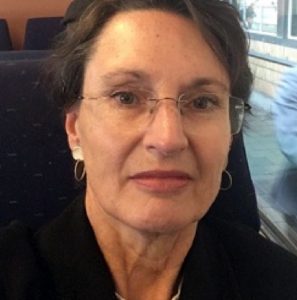
LAURA WRIGHT
Professor of English Language at the University of Cambridge
Biography
Prof. Wright is a historical sociolinguist, who has worked extensively on the history of Standard English and the London dialect, including mixed-language texts written in Anglo-Norman, Medieval Latin and Middle English, as well as 17th, 18th and 19th century London English. In this regard, her work has focused on the language of 17th and early 18th century slaves and settlers on the Island of St Helena, South Atlantic; on the language of 18th century London trade-cards and servants’ bills – in particular, those of fireworkers and their fireworks, the linguistic conventions adopted by servants and masters when advertising for work, and the effects of Victorian technological developments on colour terms and perfume names. Prof. Wright’s influential publications include monographs and edited volumes, as well as journal articles and book chapters on topics that range from historical codeswitching to the development of Standard English, and the fate of London English taken to North America and elsewhere, including the East India Company island of St Helena, South Atlantic. Her recent work includes Southern English Varieties: Then and Now (Mouton de Gruyter, 2018), Sunnyside: A Sociolinguistic History of British House Names (Oxford UP, 2020), The Multilingual Origins of Standard English (Mouton de Gruyter, 2020), which rewrites the history of Standard English, and The Social Life of Words: A Historical Approach (Wiley Blackwell, 2023).
Abstract
«On how the London placename Limehouse became enregistered in
Late Modern English»
The ‘specific social group’ of my talk is Victorian East London dockworkers, and what makes them ‘other’ is that they were physically and socially isolated and poor, making their voices ‘unheard and forgotten’. Theoretical approaches invoked are the concepts of lexical sociolinguistics, indexicality and enregisterment, the influencer-effect and language appropriation. Data comes from quasi-journalistic/fictional writing, and newly-instantiated streetnames in newly-built docks. I aim to show how a far-distant point on the globe, namely China, became correlated with streets in a London dockworkers’ hamlet, and how this correlation then later spread, firstly via fiction, and then via Hollywood films, so that Limehouse in London’s East End became a byword for opium dens, “yellow peril”, “the white slave-trade”, and a sort of sinister glamour – so much so that wealthy West End habitués would come of an evening in search of decadence there, although without much success.